
Brian Marvin
Published September 15, 2026
Named Agents vs Ephemeral Agents: Why a Folder Tree Is Enough Until It Is Not
A developer friend put the whole agent debate in one sentence. An agent is a folder tree of prompts, and the named personalities are theater for end users. He is half right, and the half he is right about saves real money.
I have been turning over an argument about Grokbot style named agents versus spawning agents on the fly. The developer view is clean. You need work done, you spin up an agent with a short instruction set, it runs, it vanishes. No names, no personality, no ceremony. I build this way too. When I need a thousand tickets processed, I want a thousand identical stateless runs, not a thousand characters with backstories.
The other side keeps winning in the market, though. xAI shipped Grok Bot as always on AI teammates, announced August 11, 2026 in beta, each with its own cloud computer, its own memory, and the ability to hand work to other agents. Business users love it. So the question is not which side is smarter. It is where the folder tree stops being enough.
What Grok Bot actually ships
Strip the launch language and Grok Bot is four concrete mechanisms. Each agent gets a name, a title, and a description, and the description does routing work. When an agent hits a task outside its scope, it scans the descriptions of the other agents and forwards the task instead of attempting it directly. A general assistant leans on a dev agent the moment a request turns technical, with no window switching by the user.
Each agent also gets its own persistent cloud computer, a remote desktop it controls. You can watch its screen, take over the browser, log into a service, and hand control back. Logins persist across sessions. Because the computer lives in the cloud, scheduled routines fire at 7am whether your laptop is open or not. That is the always on claim, and it is literal.
Skills come from demonstration. You perform a task once on the agent's machine and the recording becomes a reusable skill. The interesting part is that agents refine the skill after running it. In the demonstrated example, an agent running a like posts skill could not tell whether a post was already liked, so it rewrote its own instructions to open each post first. Routines sit on top as scheduled or trigger based automation, with Slack messages, GitHub events, and Teams messages as named triggers. A working Slack triggered alert took a couple of minutes and one prompt in the demo.
Plugin connections are shared across every agent on the account. Connect GitHub once through the dev agent and the assistant agent uses the same connection. One authorization, one calendar, one inbox, many narrow agents. The platform guidance is explicit: build narrow single purpose agents, one job each, rather than one broad agent that does everything. Access currently requires a Cursor Ultra plan, so it arrives bundled inside a coding subscription rather than as a standalone product.
Why ephemeral wins for developers
Ephemeral means stateless by design. The session starts, the agent receives a system prompt plus the current input, it reasons, calls tools, delivers output, and all context is discarded. The next session starts from the base prompt with a blank slate.
For a developer this is a feature list, not a limitation. Token spend stays proportional to the task because no personality wrapper pads the context. Behavior stays reproducible because every run starts from the same prompt, which matters for testing and auditing. Scaling stays trivial because no shared state means no session affinity. Sensitive work stays safer because nothing is retained between clients. A legal review agent that forgets each contract after reading it is doing exactly what compliance wants.
Ephemeral is not dumb, either. Chain of thought reasoning, multi step tool use, retrieval, and planning all work inside a single session. The word describes what the agent retains, not what it can do in the moment. When my friend says he spawns agents on the fly with a simple instruction set and never names them, he is describing the correct architecture for one off analytical work, batch processing, and prototypes. I run the same pattern daily through loop based execution. Simple instruction in, verified artifact out.
Why named persistent agents win on recurring work
Persistent means stateful. The agent reads from external memory at session start, works the current task with retrieved history in context, and writes back extracted insights at the end. Frameworks like Mem0, Zep, and LangMem handle the storage layer, and the best practice is to store insights, not transcripts. User prefers concise bullet summaries beats five hundred lines of chat history on cost and on retrieval quality.
The performance gap shows up in duration, not in single prompts. Vendor benchmarks from Computer Agents over 7 to 14 day runs tell a consistent story. One shot research is nearly tied at 92 versus 94 percent. A three to five file refactor done without re prompting goes 68 percent ephemeral against 91 percent persistent. A daily competitive report over seven days fully automates 22 percent of the time ephemeral against 87 percent persistent, roughly a fourfold gap. Error recovery in long tasks goes 41 versus 78 percent. Cost per hundred complex tasks runs $18 to $42 ephemeral against $9 to $21 persistent, about half over time, because the persistent agent stops relearning the context every session. Hallucination and context drift past five steps drops from 29 to 11 percent.
Treat those numbers as one vendor's runs, not physics. The direction matches everything I see in production, though. A support agent that remembers Customer A needs extra care on billing, a coding agent that knows which approaches were already rejected, a planner that knows your calendar patterns by session twenty, these compound. Ephemeral never escapes day one. That is the whole case for names and memory in one line. The name is the handle the user holds. The memory is the value that accrues behind it.
The folder tree is still the implementation
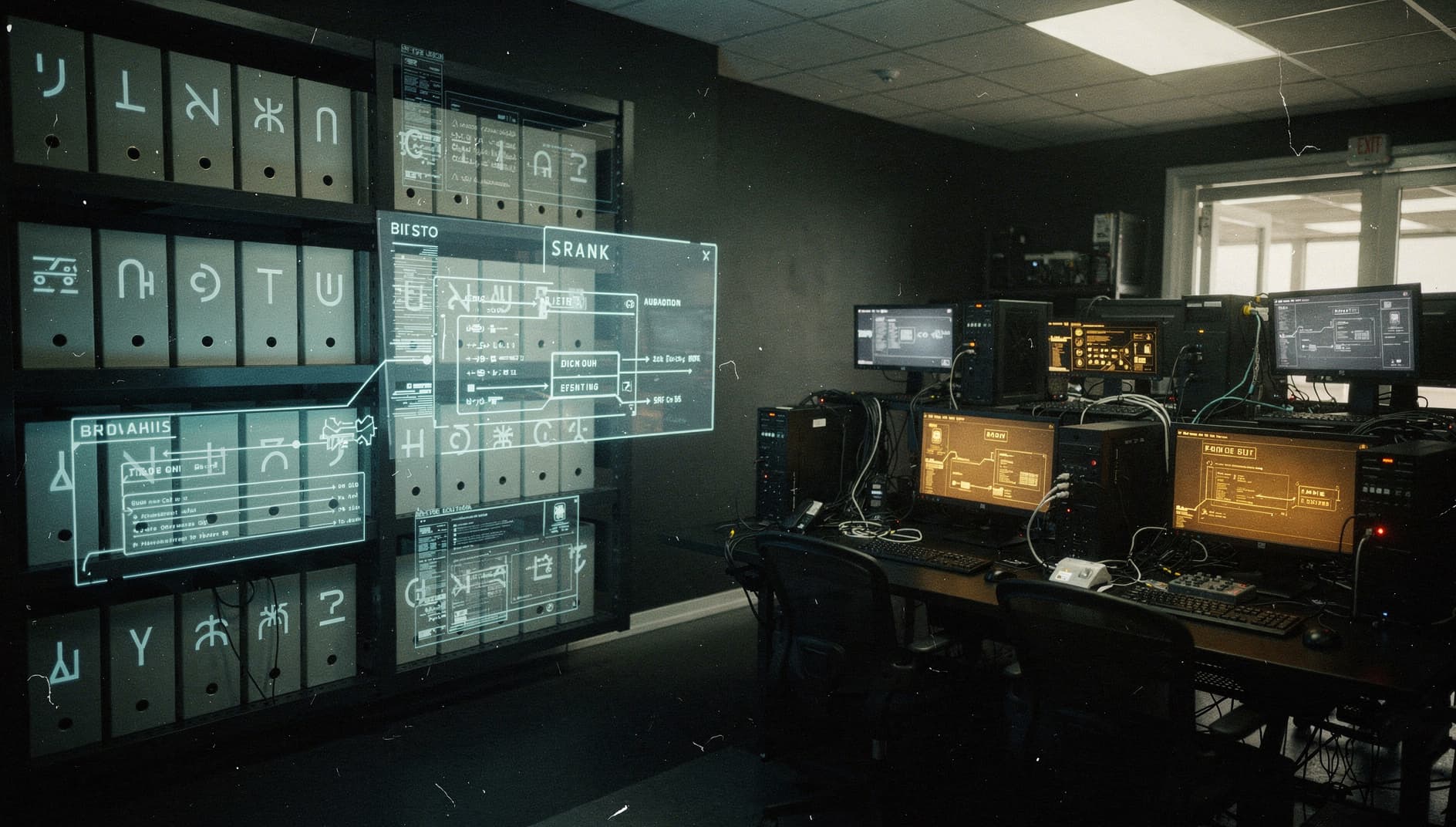
Here is where my friend is right and everyone should admit it. Underneath the named fleet, the implementation is a directory of instructions.
root/
  marketing/
    instructions.md
    schema.json
    copywriting/
      instructions.md
      tool_definition.json
To execute, the orchestrator reads the instructions file for the path, injects runtime context, calls the model, and terminates. Deterministic, fast, debuggable. CrewAI, AutoGen, and LangChain all work, and each adds real orchestration, memory management, tool use, and error recovery. They also add layers of classes, event listeners, and messaging queues that feel like enormous boilerplate when the job is a few API calls and file reads. For linear work, that abstraction is pure overhead, and teams that adopt graph frameworks for straight line workflows pay complexity without benefit.
The Open WebUI parallel my friend raised is apt. Modular prompts plus tool definitions plus a router covered most needs years ago. Two routing options still cover most needs today: a router model that reads the folders and picks the path by meaning, or a hardcoded switch on intent and API inputs. Start with the switch. Promote to the router when the folder count earns it.
Where the complexity is real and where it is theater
Three problems force real complexity onto the folder tree, and they are worth naming so you buy solutions to the right ones.
Memory across sessions is the first. Static text files reset to zero every run. Crossing that gap needs a vector store or knowledge graph, read and write calls in the loop, and retention policy. That is genuine infrastructure, and it is the price of the compounding above.
Self correction loops are the second. Linear execution is easy. Recovery is not. The agent runs a tool, the API errors, the agent must reread its instructions, modify the query, and try a different subfolder without spiraling. Managing those retries without standard engineering patterns turns into spaghetti fast. This is the ReAct shaped problem, and it deserves code, not vibes.
Multi human coordination is the third. My friend coordinates many robots with ephemeral workers, and Hermes style delegation fits that shape. Grok Bot coordinates many humans through one gateway with access groups and channel routing. Neither is automatically right. Many robots favors stateless workers under a persistent supervisor. Many humans favors named agents with narrow jobs and shared connections.
Everything else is presentation. Backstories, avatars, and banter do not change routing, memory, or recovery. They change whether a non technical user trusts the system enough to delegate to it. That trust has business value, and anthropomorphism is how humans grant it. Call it UI, budget it as UI, and do not confuse it with architecture. The personality is the interface to the configuration, the way a job title is the interface to a role.
The test I would run
Run both shapes for two weeks on work you already do. Put one recurring workflow, a daily report, a triage queue, a monitoring check, on a named persistent agent with memory and a schedule. Put one batch workload, a thousand tickets, a backfill, a one off analysis, on ephemeral workers with frozen prompts. Measure completion without re prompting, wall clock cost per hundred tasks, and supervision minutes per day.
My prediction from orchestration and spend work and the deterministic versus stochastic breakdown: the batch workload ties or favors ephemeral, and the recurring workflow favors persistent by multiples. That split is also the buying guide. Ephemeral when the task is truly one off, when you need zero retained state, or when you are prototyping. Persistent when work continues while you are offline, when schedules and triggers replace glue code, and when quality should compound across days.
For platform builders, the merge is the product. Keep the backend a clean instruction tree with explicit schemas, stateless by default. Wrap the recurring paths in named agents with memory, schedules, and shared connections so everyday users know what to click. My friend built Simply Managed AI on the tree, and the marketplace of named templates is the layer that takes that tree to people who think in delegation rather than instruction sets. Folders underneath, colleagues on the surface. That is not overbuilding. That is the whole design.
About the Author
I'm Brian Marvin, an AI-native Fractional CTO with 30 years in technical leadership. At empowered.guru, I help startups build MVPs, shape roadmaps, and make AI-powered technology decisions that scale.